
How to determine risk tolerance sets the stage for this enthralling narrative, offering readers a glimpse into a story that is rich in detail with casual formal language style and brimming with originality from the outset.
Understanding risk tolerance is a key aspect of making sound investment decisions. This guide will delve into the various factors and strategies involved in assessing and managing risk tolerance effectively.
Introduction to Risk Tolerance
Risk tolerance refers to an individual’s ability to handle fluctuations in the value of their investments. It is a crucial aspect of financial planning as it helps determine the level of risk an investor is comfortable with.
Understanding risk tolerance is essential for making informed investment decisions. It allows investors to align their investment strategies with their comfort level, ensuring they can stay committed to their financial goals even during market volatility.
Difference between Risk Tolerance, Risk Capacity, and Risk Appetite
Risk tolerance should not be confused with risk capacity or risk appetite, as they each play distinct roles in the investment decision-making process.
- Risk Tolerance: This refers to the psychological and emotional willingness of an individual to endure risk in their investment portfolio.
- Risk Capacity: This represents the financial ability of an investor to take on risk based on factors such as income, assets, and time horizon.
- Risk Appetite: This reflects the level of risk an investor is willing to take to achieve their financial goals, often influenced by their investment preferences and objectives.
Factors Influencing Risk Tolerance
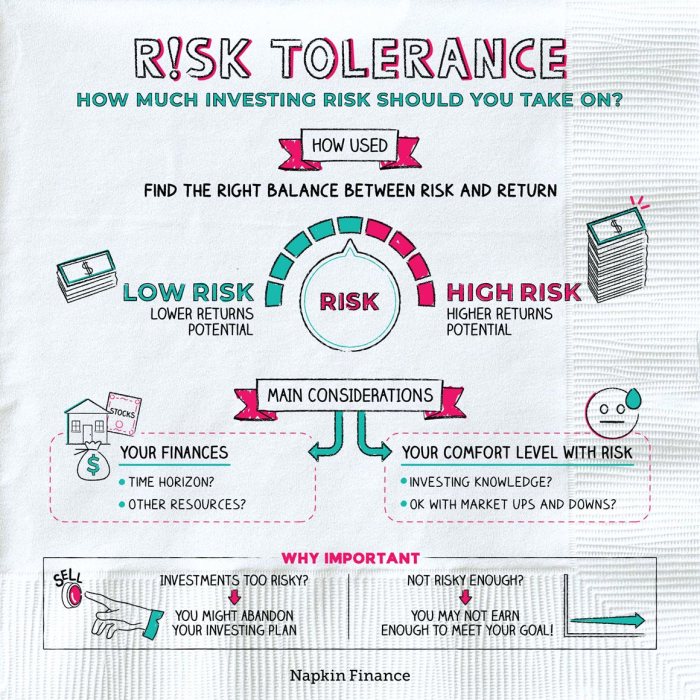
Understanding the various factors that influence an individual’s risk tolerance is crucial in making informed investment decisions.
Personal Factors
- Age: Younger individuals often have a higher risk tolerance as they have more time to recover from any losses.
- Personality: Some people are naturally more risk-averse, while others are comfortable taking on more risk.
- Knowledge and Experience: Those with a greater understanding of financial markets may have a higher risk tolerance.
Financial Goals and Time Horizon
- Short-term goals may require a lower risk tolerance to protect capital, while long-term goals could allow for more risk-taking to potentially achieve higher returns.
- Time horizon plays a significant role, with longer timeframes often associated with higher risk tolerance due to the ability to ride out market fluctuations.
Role of Past Investment Experiences
- Previous investment successes or failures can impact risk tolerance, with individuals who have experienced losses likely to be more risk-averse.
- Learning from past mistakes can also lead to a reassessment of risk tolerance and a more conservative approach to investing.
Assessing Risk Tolerance
Assessing risk tolerance is a crucial step in financial planning to ensure that investments align with an individual’s comfort level. There are various methods to gauge risk tolerance, each with its own strengths and limitations.
Risk Tolerance Questionnaires vs. Psychometric Tests
Risk tolerance questionnaires are commonly used tools to assess an individual’s risk appetite. These questionnaires typically consist of a series of questions related to financial preferences, investment goals, and reactions to hypothetical scenarios. The answers are then used to determine the individual’s risk tolerance level.
On the other hand, psychometric tests delve deeper into an individual’s psychological makeup to gauge their risk tolerance. These tests may involve analyzing personality traits, decision-making processes, and emotional responses to uncertainty. While more comprehensive, psychometric tests may require professional interpretation.
Considering Emotional Responses to Financial Risks
Emotional responses play a significant role in determining risk tolerance. Fear, greed, and anxiety can heavily influence investment decisions. Individuals may overestimate their risk tolerance in a bull market and panic during a downturn, leading to poor financial choices.
It is crucial to consider emotional responses when assessing risk tolerance to ensure that investment strategies are aligned with an individual’s true capacity to handle financial uncertainty. Understanding how emotions impact decision-making can help in creating a more balanced and suitable investment portfolio.
Strategies for Managing Risk Tolerance
When it comes to managing risk tolerance, there are several strategies that investors can implement to ensure their investments align with their risk tolerance levels. These strategies help in balancing risk and return to achieve financial goals effectively.
Aligning Investments with Risk Tolerance Levels
One key strategy for managing risk tolerance is aligning investments with an individual’s risk tolerance levels. This involves selecting investment products that match the investor’s comfort level with risk. For example, conservative investors may opt for low-risk investments such as bonds or money market funds, while aggressive investors may choose high-risk investments like equities or derivatives.
Diversification in Managing Risk Tolerance
Diversification plays a crucial role in managing risk tolerance. By spreading investments across different asset classes, sectors, and geographical regions, investors can reduce the impact of market fluctuations on their overall portfolio. This strategy helps in minimizing the risk of significant losses while potentially maximizing returns.
Role of Periodic Reviews and Adjustments
Periodic reviews and adjustments are essential in managing risk tolerance effectively. Investors should regularly assess their risk tolerance levels, financial goals, and market conditions to ensure that their investment strategy remains aligned with their objectives. By making necessary adjustments to their portfolio, investors can maintain an optimal balance between risk and return over time.
Relationship Between Risk Tolerance and Risk Management
Understanding the relationship between risk tolerance and risk management is crucial for investors to make informed decisions and construct a suitable portfolio.
Influence of Risk Tolerance on Risk Management Strategies
Investors with high risk tolerance are more likely to engage in aggressive investment strategies, such as investing in high-risk assets like stocks and commodities. On the other hand, investors with low risk tolerance prefer conservative investments like bonds and cash equivalents. Risk management strategies need to align with an individual’s risk tolerance to ensure a balanced and suitable investment approach.
Impact of Risk Tolerance on Portfolio Construction and Asset Allocation
Risk tolerance directly influences portfolio construction and asset allocation decisions. Investors with a high risk tolerance may allocate a larger portion of their portfolio to equities, aiming for higher returns despite higher volatility. Conversely, investors with low risk tolerance may opt for a more conservative asset allocation with a focus on capital preservation.
Role of Risk Management Frameworks in Navigating Risk Tolerance Levels
Risk management frameworks provide a structured approach to help individuals navigate their risk tolerance levels effectively. By assessing risk factors, setting risk management goals, and implementing risk mitigation strategies, investors can align their risk tolerance with their investment objectives and make informed decisions in volatile market conditions.
In conclusion, determining risk tolerance is a nuanced process that requires careful consideration of personal factors and financial goals. By understanding your risk tolerance, you can make informed investment decisions that align with your objectives and comfort level.
Questions and Answers
What is risk tolerance?
Risk tolerance refers to an individual’s willingness and ability to handle fluctuations in the value of their investments.
How do past investment experiences influence risk tolerance?
Past investment experiences can shape risk tolerance by either increasing or decreasing an individual’s comfort level with risk.
Why is it important to consider emotional responses to financial risks?
Emotional responses to financial risks can impact decision-making and risk tolerance, making it crucial to address these aspects when assessing risk tolerance.


